
Equity Market Updates


US equities closed higher, supported by gains in healthcare and real estate, while European markets weakened and Asian markets were mixed. US labour market data showed further moderation in hiring, although unemployment remains relatively low at 4.2%, suggesting the economy remains resilient.
Treasury yields declined, providing support for equities, while the US Dollar weakened modestly. Although persistent inflation remains a concern, markets expect the Federal Reserve to maintain current interest rates. Overall, the outlook is cautiously positive, as resilient economic conditions support the markets despite ongoing interest rate uncertainty.
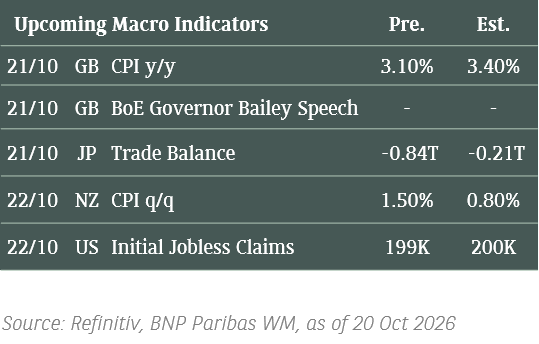
Equity Market Updates

European stocks fell on Tuesday as protests in France continued to dampen investor sentiment within the region.
Within Europe, we maintain relative preference towards more defensive areas of utilities and healthcare.
SpaceX (SPCX US)
Shares of SpaceX surged more than 7% during after-market hours on Tuesday as it reported Q3 top- and bottom-line figures that beat market expectations, featuring revenue that grew 161% YoY. The beat was driven by substantial growth in its AI and satellite internet businesses. Separately, CEO Elon Musk said that both SpaceX and Tesla have formed special committees to explore a potential merger.
MARKET CONSENSUS: 37 BUYS, 7 HOLDS, 4 SELLS, AVERAGE TP USD223.62
Netflix (NFLX US)
Shares of Netflix fell more than 5% in after-market trading as it reported its slowest sales jump in three years and forecast a fourth consecutive quarter of slowing growth. The company blamed the slowdown on its advertising business, which is on pace to deliver USD300mln less than expected. In terms of overall Q3 results, Netflix’s adjusted EPS came in at USD0.87 vs. USD0.83 expected, while revenue was at USD12.9bln, in line with expectations.
MARKET CONSENSUS: 48 BUYS, 15 HOLDS, 2 SELLS, AVERAGE TP USD92.08
Qualcomm (QCOM US)
Qualcomm said on Tuesday that it will cut jobs globally in a “performance-focused reduction” following its annual employee reviews. The cuts are part of an effort to build "a stronger performance culture" and address situations where the company "has consistently fallen short of expectations.“
MARKET CONSENSUS: 19 BUYS, 23 HOLDS, 3 SELLS, AVERAGE TP USD199.89
3M (MMM US)
Shares of 3M rose by as much as 5.8% on Tuesday after raising its FY26 adjusted EPS guidance to USD9.15 at the upper end, up USD0.20 from its previous forecast. The company also announced a partnership with Amazon to supply data centre connectivity products from 2027. Q3 net sales grew 1% YoY to USD 6.6bln, with continued margin expansion, double-digit adjusted EPS growth and robust free cash flow.
MARKET CONSENSUS: 10 BUYS, 8 HOLDS, 1 SELL, AVERAGE TP USD190.94
CATL (3750 HK)
Chinese battery maker CATL on Tuesday reported Q3 results that missed market expectations, hit by fierce competition in the Chinese electric vehicle battery market as the country’s auto sales growth also cooled. The company’s Q3 revenue came in at RMB165.2bln vs. RMB175.1bln expected, while net income stood at RMB21.3bln vs. RMB26.0bln expected.
MARKET CONSENSUS: 23 BUYS, 3 HOLDS, AVERAGE TP HKD715.75
Mizuho Financial Group (8411 JP)
Mizuho and Daiwa Securities was reported on Tuesday to have received green lights to launch wholly owned mainland China securities businesses, leaving some US rivals in limbo on the long-running approval waitlist. The official nods came after Chinese Vice Premier He hosted a senior trade delegation from Japan in March to discuss expanding bilateral trade and cross-border corporate investment.
MARKET CONSENSUS: 11 BUYS, 3 HOLDS, AVERAGE TP JPY10010
Earnings Announcements
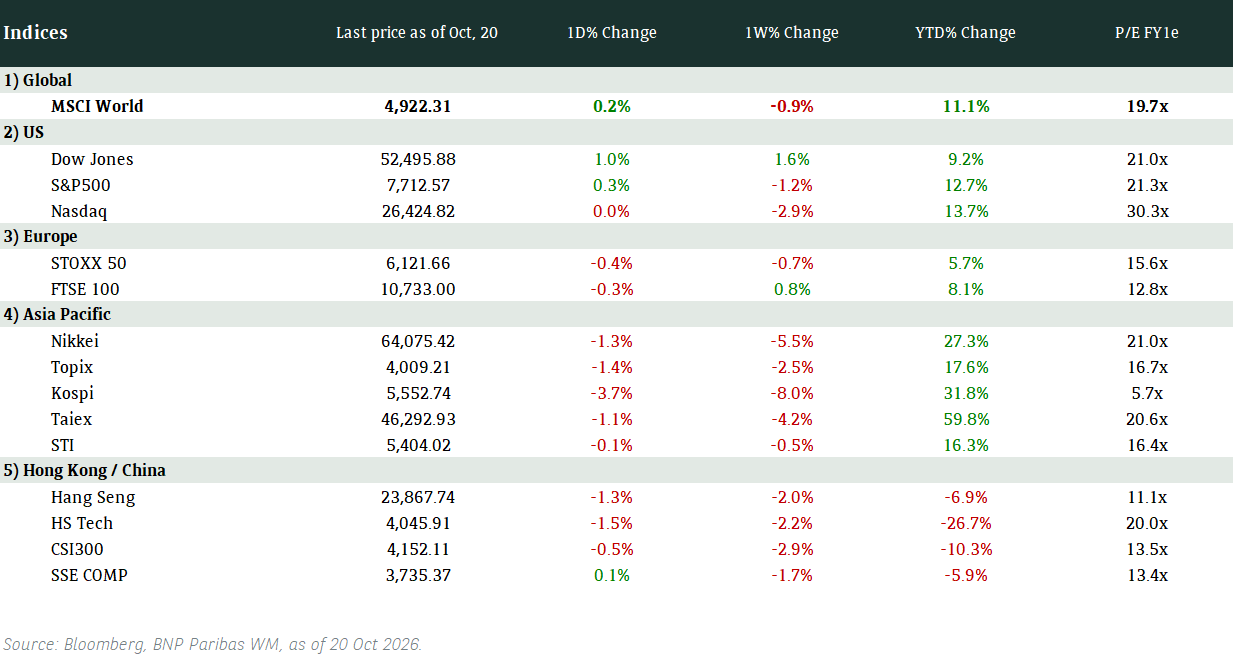
Global Indices Changes (%)
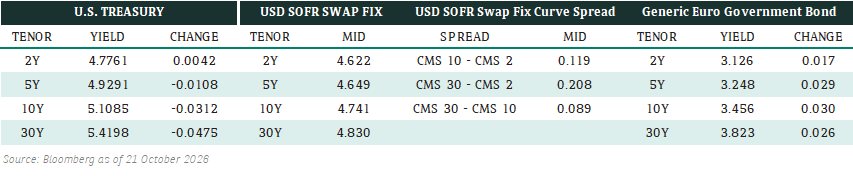
Fixed Income Market Updates

The overall market sentiment remains cautious. Looking ahead, investors are focused on whether the equity rebound can be sustained amid concerns regarding AI capital expenditure and elevated interest rates. Additionally, heavy USD corporate issuance has contributed to upward pressure on yields.
European Bank coco (AT1)
Sentiment is currently nervous, with prices dropping as rising oil prices and government budget struggles in France put pressure on risk. We expect a period of volatility to continue until a sense of calm returns to the broader financial markets. We don't believe issues are structural.
Asia Investment Grade (IG)
Price action remains soft across Asia, with spreads widening as investors sell off holdings in the technology, media, and telecommunications sector, specifically affecting Tencent and Tencent Music. There is some steady buying interest in high-quality names from Temasek in Singapore and Korean Air bonds guaranteed by Korea Development Bank. We anticipate that the market will stay muted as investors wait for clearer signals from the macro environment.
Asia High Yield (HY)
The outlook for HY bonds is weaker, with significant selling pressure seen in Indonesian companies and Macau gaming bonds. Many investors are reducing their exposure, leading to a drop in prices for names like Genm Marketing and Genting Plantations. We expect this downward pressure to persist as long as investor confidence remains low in these specific regions.
Forex Market Updates
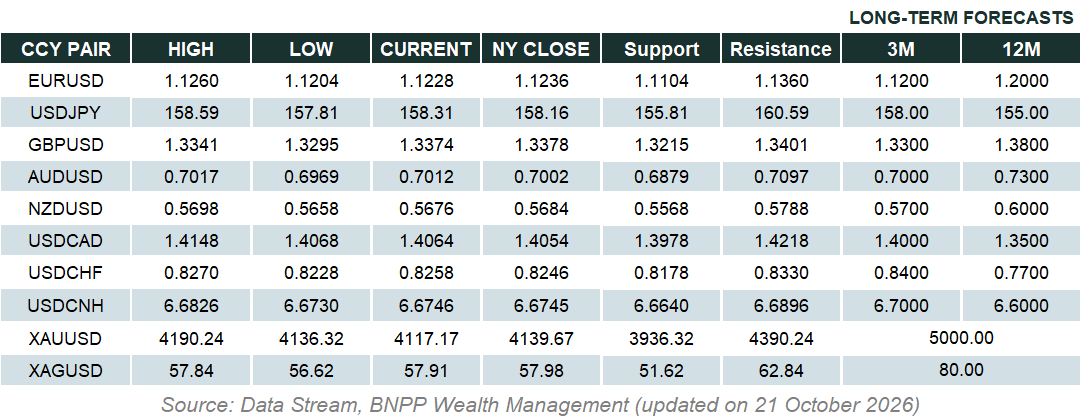
The Dollar index was down at 101.71 on Tuesday, near the lower end of October’s trading range, as easing pressure on the Euros offset the dollar’s earlier gains.
USD
The Dollar index was down at 101.71 on Tuesday, near the lower end of October’s trading range, as easing pressure on the Euros offset the dollar’s earlier gains. The greenback remains caught between two competing macro forces namely the AI-equity correlation as tech-driven market volatility reduces Fed tightening expectations and weakens the dollar while the ongoing Hormuz Iran escalation keeping oil at five month highs above $109 per barrel, which sustains inflationary pressure and keeps the December hike at 92% probability. With the Fed in its pre-meeting blackout and no major US data due this week, the dollar’s near term direction is almost entirely determined by geopolitical developments and the equity rate dynamic.
The Dollar may remain supported at the 101.50 level as market anticipates October 28 FOMC.
GBP
Sterling rose against the dollar to $1.3380 on Tuesday after British jobs data showed signs of a recovery in the labour market, according to Reuters. A preliminary measure of payrolled employees rose, the unemployment rate fell, and average hourly earnings grew faster than expected in the three months to August. Money market futures were almost fully pricing in a quarter point rate hike when the Bank of England announces policy on November 5, with investors also fully pricing four rate hikes by mid 2027.
The Sterling may strengthen in the near term on the backdrop of stable politics and resilient labour market.
EUR
The Euro steadied on Tuesday at around $1.1230, as unrest in France eased overnight following authorities setting curfews in several cities on Monday to curb nationwide anti-government protests, according to Reuters. The reprieve is likely temporary as France will remain in the spotlight on Wednesday as the lower house is set to vote on the revenue section of the proposed 2027 budget which is a vote that carries direct implications for the fiscal credibility concerns that have been driving the OAT-Bund spread wider. EUR/USD had hit its lowest since May 2025 last week at $1.1113 and has since staged a partial recovery driven by the dollar’s sideways drift rather than any EUR specific improvement.
The Euro may looks towards Wednesday’s French budget as the near term binary.
XAU
Gold fell to around $4,118 on Tuesday, declining for a third consecutive session after again failing to hold above the $4,200 resistance level, as soaring oil prices paradoxically intensified the headwinds rather than supporting the metal. Brent crude rose above $111 per barrel reaching a five-month high following Houthi rebel claims of attacks on several Saudi targets including energy and airport infrastructure, while Iran’s navy said the US had continued operations in the Strait of Hormuz. The metal has been confined to a $4,063 to $4,227 range for almost three weeks, with the upside capped by oil driven rate pressure and the downside limited by structural central bank buying demand and de-dollarisation flows.
Gold may consolidates between 4,120 to 4,200 in the near term with the October 28 FOMC being the decisive catalyst.
Please read carefully the disclaimer here:
Asia Disclaimer:
https://wealthmanagement.bnpparibas/asia/en/disclaimer1.html
Europe Disclaimer:
https://wealthmanagement.bnpparibas/ch/en/disclaimer.html
