


Understanding the regulations concerning responsible investing

A rapidly changing regulatory environment
Sustainability has emerged as a central issue for businesses and financial players, both at the European and international level. Faced with the climate crisis, societal pressure and growing demands from investors for more transparency, it has become essential to integrate environmental, social and governance (ESG) criteria into investment strategies. This change seeks not only to limit risks[1], but also to take advantage of new growth opportunities[2].
[1] World Economic Forum, The Global Risks Report 2026, 21st Edition, January 2026
[2] United Nations Conference on Trade and Development, World Investment Report 2020
In order to ensure the transparency, comparability and credibility of this approach, as well as to attain carbon neutrality by 2050, the European Union has had a regulatory framework in place since 2019, which is structured in particular around the following four complementary pillars:
- the EU Taxonomy
- the CSRD
- the SFDR
- the ESG amendments to MiFID II/IDD
These regulations have an impact on the consulting sector and on portfolio management, since they set out publication, classification and consulting obligations with a view to directing financial flows towards truly sustainable activities and avoiding greenwashing. They are aimed at the entire financial value chain: businesses, asset managers, distributors and advisers. Since coming into force, they have been subject to reforms aimed at reducing the administrative burden. What follows is an overview of these key regulations, which are fundamentally reshaping practices in the financial sector and bolstering stakeholder confidence.



At the heart of Europe's regulatory landscape
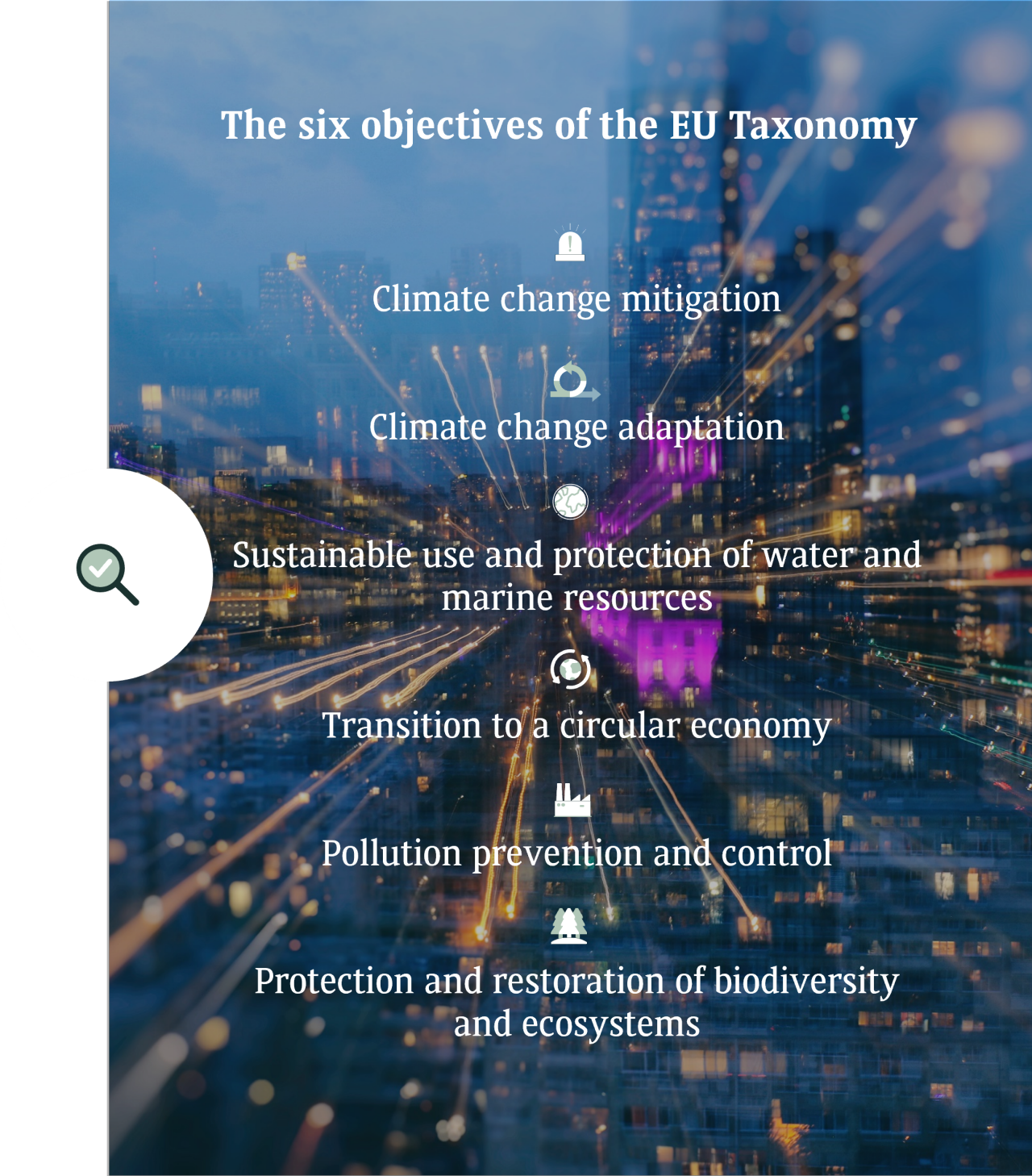
The European Taxonomy is a classification system that defines what constitutes an environmentally sustainable economic activity, using technical criteria specific to each sector. It is based on six environmental objectives.
This classification system makes it possible to identify the proportion of sustainable activities carried out by each economic player. As this percentage is one of the reporting indicators required of companies (under the CSRD) and financial players (under the SFDR), it is essential in helping investors direct their capital towards truly sustainable projects.

CSRD: ESG reporting harmonisation and requirements
The Corporate Sustainability Reporting Directive (CSRD) requires large European companies to publish detailed information on their environmental, social and governance (ESG) impact. This directive aims to harmonise non-financial reporting requirements, with the concept of “double materiality” as its cornerstone, which involves analysing:
1) The positive and negative impacts of companies on their natural, economic and social environments
2) The positive and negative impacts of sustainability issues (e.g. extreme weather events, the increasing scarcity of natural resources) on companies
The concept of double materiality has been retained in the Directive of 24 February 2026, known as Omnibus I, which narrows the scope of application of these requirements.
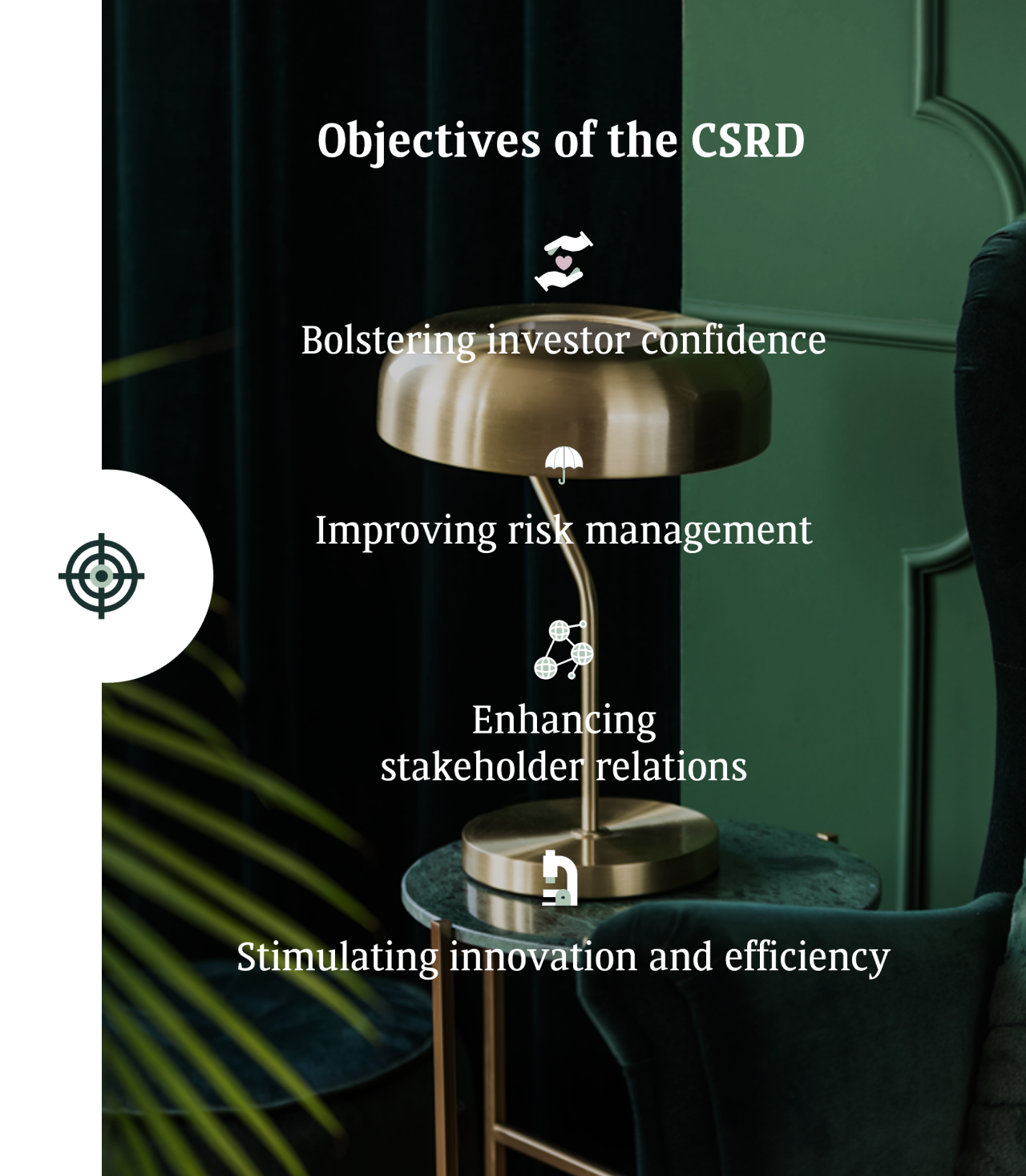
The aim remains to improve the accessibility and quality of ESG data – and, consequently, to bolster investor confidence – by drawing on European reporting standards.


The SFDR (Sustainable Finance Disclosure Regulation), which came into force in March 2021, aims to improve the transparency of financial products in relation to sustainability. It applies to funds, life insurance products, retirement savings schemes and discretionary asset management. Under this regulation, financial institutions must classify their products as “Article 6”, “Article 8” or “Article 9” products, depending on whether or not they incorporate environmental, social and governance criteria[1]
There are various strategies available for incorporating these criteria. Taking negative impacts – such as the carbon footprint, for example – into account when identifying the investable universe is one of the strategies identified. Setting a threshold for contributions to environmental objectives, based on the percentage of alignment with the taxonomy, may also serve as a criterion for selecting companies through responsible investment strategies.
This method of classifying financial products has been designed to draw on ESG data, the framework for which is set out by the European Taxonomy and the CSRD, and to inform the ESG preferences that investors can then select.
In practice, however, as the original requirements were very complex to implement, regulators are planning a new version of these regulations, introducing both simplifications and further restrictions to make fund managers’ commitments and results clearer.
[1] See Regulation (EU) 2019/2088 of the European Parliament and of the Council of 27 November 2019 on sustainability‐related disclosures in the financial services sector

The ESG amendments to the MiFID II (Markets in Financial Instruments Directive) and IDD (Insurance Distribution Directive) regulations require financial advisers to gather and incorporate their clients’ ESG preferences when providing investment and insurance advisory services, as well as discretionary asset management services.
This includes:
- Identifying and assessing clients’ ESG preferences;
- Adapting recommendations and suitability checks accordingly.
Under the ESG amendments, and to align with the SFDR, clients’ ESG preferences may be directed towards “Category A”, “Category B” and/or “Category C” investments.
Within the recommended investment universe of BNP Paribas Wealth Management, the choice can be illustrated as follows:
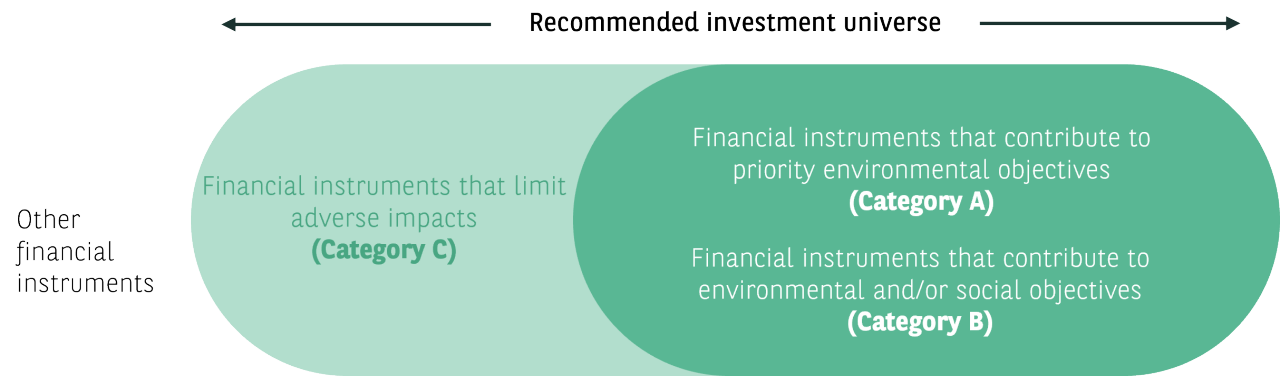
These requirements help make advice more personalised and ensure that the products offered truly meet sustainability expectations.
Summary
Taxonomy
The EU taxonomy is a classification system that sets out a list of environmentally sustainable economic activities.
Economic activities
Technical screening criteria
CSRD
Large companies must publish information relating to environmental and social issues, human rights, anti-corruption and diversity on their boards of directors.
European businesses
ESRS (European Sustainability Reporting Standards)
SFDR
Harmonisation of transparency standards to help institutional and retail investors understand, compare and monitor the ESG characteristics of their investments.
Funds, ETFs, structured products
Article 6, Article 8, Article 9
MiFID ESG
Collecting and incorporating clients’ ESG preferences into advice on investment, insurance and discretionary asset management.
Funds, ETFs, structured products, shares, bonds
Category A (Financial instruments that contribute to priority environmental objectives)
Category B (Financial instruments that contribute to environmental and/or social objectives)
Category C (Financial instruments that limit adverse impacts)