

Equity Perspectives October 2026
Latest market updates from the United States, Europe/UK, HK/China markets


Market Snapshot
◼ Bond yields surged since our September 2026 update, driven by inflation concerns and massive AI financing requirements.
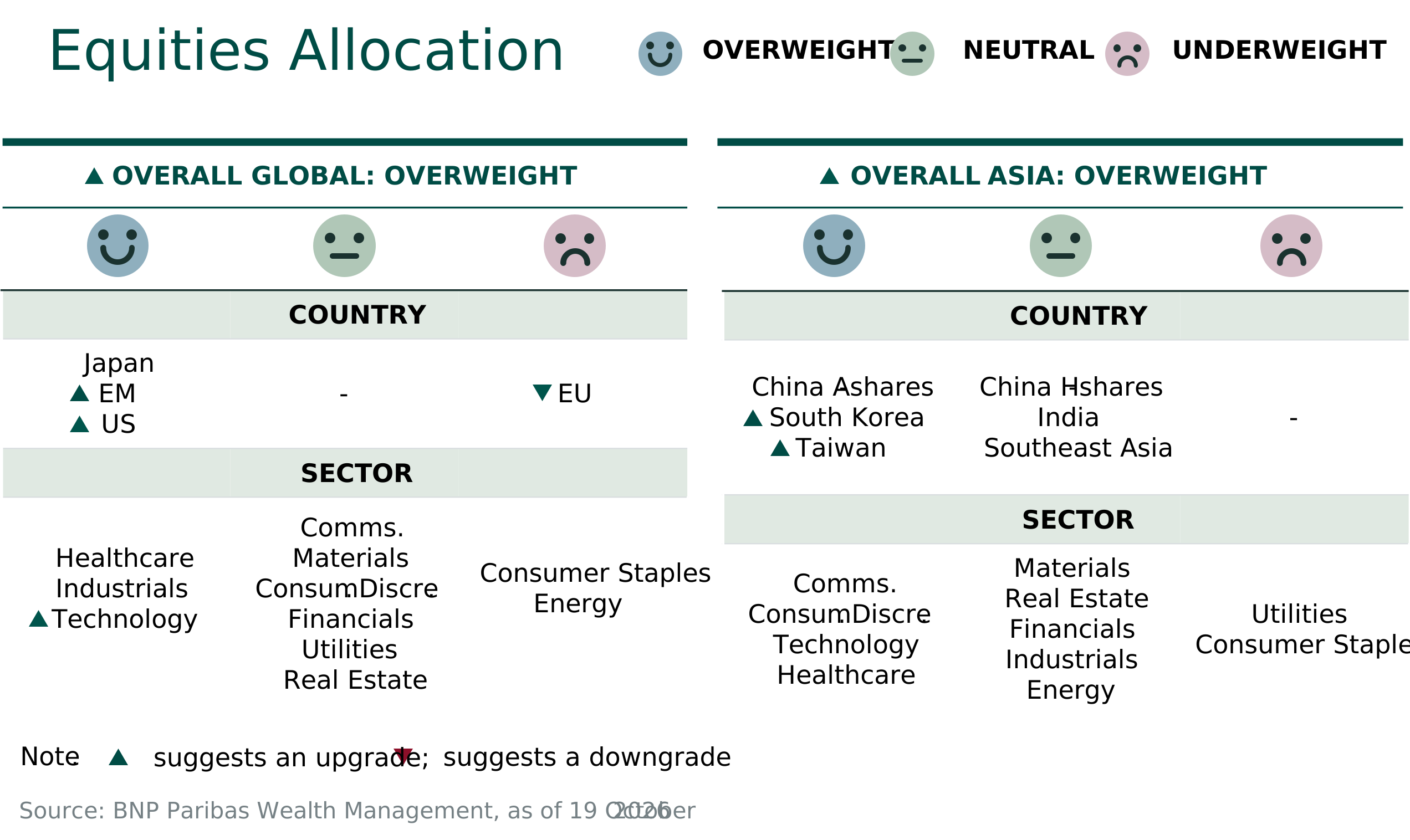
◼ Nevertheless, despite some volatility, global stock markets remained remarkably resilient, buoyed by superior earnings growth in most major regions. With historical post-midterm seasonality being an added tailwind, we are now overweight global equities.
◼ We have also upgraded US equities to overweight as the country’s corporate earnings momentum remains exceptionally strong, driven by the accelerating deployment of AI infrastructure which is now meeting real-world end-user demand.
◼ Meanwhile, we turned underweight on European stocks. This does not reflect a bearish stance, although it does reflect the region’s position as the weakest link among global peers amid persistent headwinds such as weak domestic consumption and fiscal challenges.

📑Hong Kong/China Updates

📑US Updates

📑Europe/UK Updates


Hong Kong/China: Resilient GDP growth keeps stimulus out the gate
What happened?
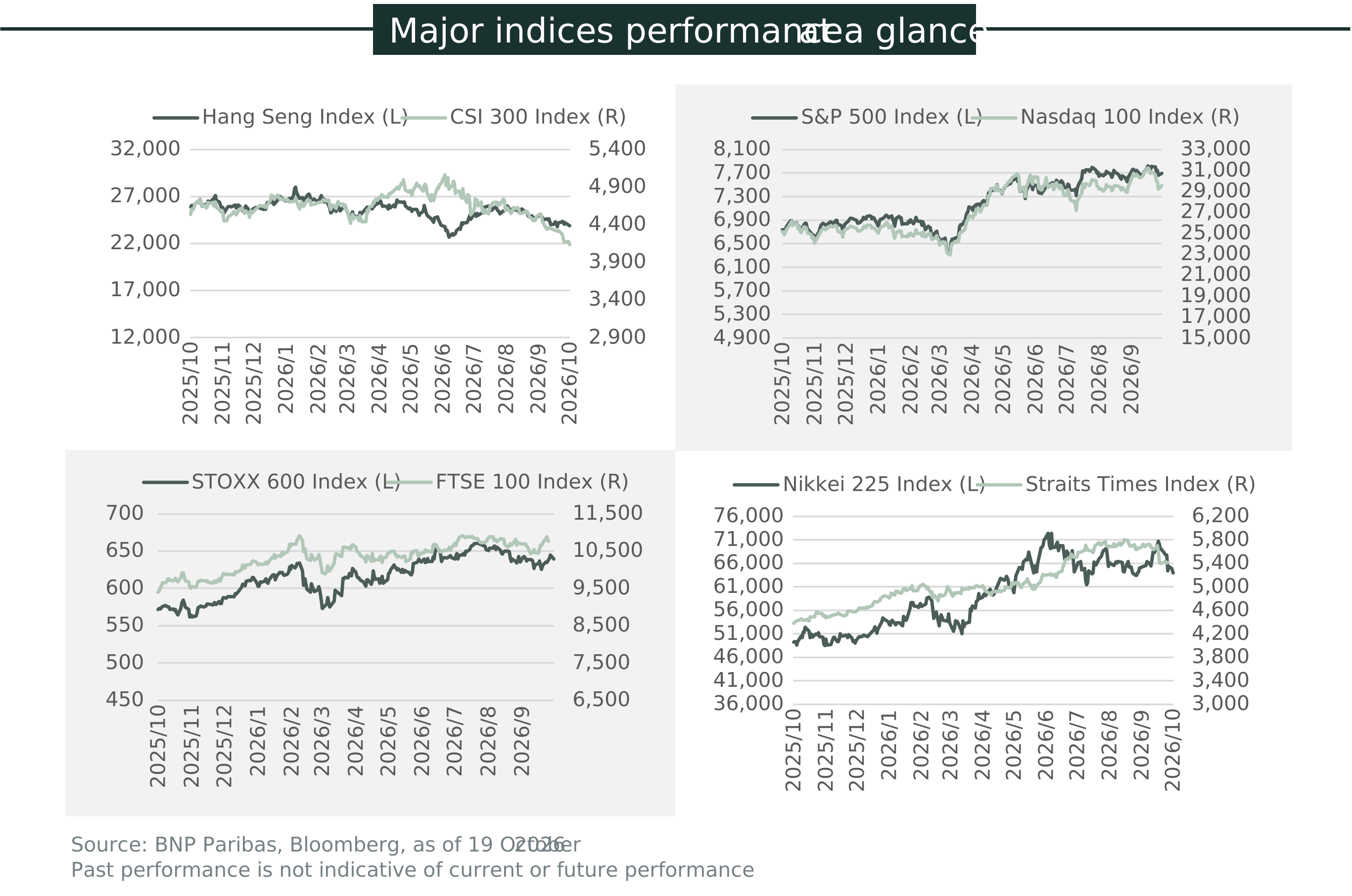
China’s CSI300 index has lost 17% since June 30, 2026 (as of October 21 2026), amid fading stimulus momentum and an aggressive reversal in tech sentiment. Meanwhile, Q3 2026 GDP growth of 4.5% year-on-year was slightly better-than-expected, and a mini-stimulus package for Q4 2026 has already been introduced to bridge potential growth gaps. However, with year-to-date growth at 4.6%, the economy needs only 4.2% growth in Q4 2026 to meet the annual target of 4.5-5.0%. Therefore, the urgency for additional fiscal stimulus, which could trigger market rerating, is low in our view.
Hang Seng TECH Index, which has been bitterly criticised for its misalignment between its namesake “tech index” and high concentration of e-commerce & electric vehicle companies, announced major methodology changes to raise exposure to hardware and artificial intelligence, effective in December 2026. As of mid-2026, the total assets under management tracking Hang Seng TECH Index reached a remarkable size of approximately US$40.4 billion. On top of near-term trading opportunities from concentrated rebalancing by index tracking funds, the radical overhaul may help Hong Kong stock market to regain interests from global investors in the long-term.
Our thoughts
◼ The underlying economic growth remains highly uneven. The “K-shaped” macro backdrop reinforced our confidence in the barbell strategy with a narrow focus on government-blessed industries and high-dividend blue chips.
◼ Healthcare has been the best performing sector in the Hang Seng Composite Index since mid-2026. The list of international drugmakers partnering with biotech labs in China is growing. China’s pharmaceutical out-licensing boom is setting a record in 2026, with cross-border out-licensing deals surpassed US$139 billion by October 2026, per data provider PharmCube.
How to play the game?
🎯Areas on our radar: Details of new policies in accordance with China’s 15th Five-Year Plan, anti-involution policies, China AI development.
🔎Investment implications: Emerging industries highlighted in China’s 15th Five-Year are expected to meet new favourable policies. Selected consumer brands which have pricing power.
Notable Developments in Selected Sectors
◼ Healthcare: The Ministry of Commerce confirmed that the proposed update to export controls do not include international out-licensing deals and out-sourcing collaborations. The official clarification cleared the initial misinterpretation that these major industry growth drivers will hit policy speedbumps.
◼ Tech and Telecom: China plans to ramp up information technology infrastructure rapidly in 2026-2030, including a 5.2 times increase in AI compute capacity to 9,800 EFLOPS and 50-fold increase in the number of 50G-PON ports, according to the Ministry of Industry and Information Technology.
◼ Automobile: Previous concerns regarding two major policy overhangs on Chinese automobile industry – reduction of export-tax rebate by the Chinese government and volume cap on imports of Chinese hybrid vehicle by the European Union – are now confirmed. The situation is complicated by the fact that rapidly growing exports year to-date have been the sole buffer to offset lingering weakness in the domestic car market. Along the supply chain, we prefer battery makers which enjoy strong global demand for energy storage system.

US: Fundamentals still supportive. Near-term focus on mid-term elections & AI capex
What happened?
US equities saw choppy trading in recent months, with lingering investor unease over higher bond yields and AI data center buildout particularly weighing on semiconductor stocks, while software stocks recouped much of its losses from 1H26 with improved inflows rotating back in Q3 2026. As we look towards 2027, we favour staying invested in the equity market and broadening investments across sectors. This stance issupported by resilient growth outlook, limited Fed rate hikes expected by our CIO office and still solid earnings growth forecast of ~17.7% for MSCI US index next year.
Our thoughts
◼ Watch for accumulation opportunities – In our view, near term equity market volatility could pick up ahead of the mid-term elections on 3 November 2026, which could reset post election after event uncertainties ease as market focus returns to corporate fundamentals and Q3 2026 reporting season, which should peak with most hyperscalers scheduled to report end October 2026.
◼Q3 2026 reporting season is expected to deliver a third consecutive quarter of earnings growth above 25%, which should mark the eighth straight quarter of double-digit percentage earnings growth. Estimates show that AI infrastructure spending beneficiaries are likely to account for more than half of S&P 500 earnings per share (EPS) growth for Q3 2026. Following recent street forecast upgrades amid positive earnings revision breadth, FY26E earnings growth for MSCI US is estimated at a robust 33.9% (source: IBES estimates, as of 12 October 2026), higher than MSCI World’s 29.4% forecast.
◼AI monetisation and productivity will remain under the spotlight – In the recent Q2 2026 reporting season, hyperscalers’ cloud revenues and cloud order backlogs showed encouraging signs of acceleration. We expect investors to remain focused on US megacaps’ AI related commentary to obtain clues on the pace of AI capex growth into 2027, which we believe will stay elevated.
◼On key calls, we continue to favor broadening investments across sectors beyond Tech. We specifically highlight Industrials, Utilities, and Materials, as these sectors also benefit from elevated hyperscaler capex plans. Furthermore, we see a positive medium-term risk-reward in key bottleneck areas of semiconductors, memory, and power infrastructure/electrification, where demand-supply dynamics are expected to remain imbalanced going into 2027. We continue to see favourable medium-term risk/reward proposition in healthcare stocks, which have lagged this year amid the concentrated AI thematic positioning.
How to play the game?
🎯Areas on our radar: Hyperscaler capex plans, economic growth trajectory, Fed rate decisions.
🔎Investment implications: Maintain prudence and diversification, favouring quality firms with healthy balance sheets.
Notable Developments in Selected Sectors
◼ Info. Tech: Recent weakness reflects renewed concern about AI monetisation and the funding intensity behind the trade. We continue to favour quality leaders, which have again shown better support and lower volatility over the past month. With reporting season now underway, capex commitments from hyperscalers and other key buyers will be critical to restoring confidence that AI demand remains durable and the broader AI trade is still intact.
◼ Tech and Telecom: Healthcare: Healthcare remains a defensive sector with earnings typically better insulated than the broader market during periods of economic weakness, while offering undemanding valuations. In the long term, this sector should be a key beneficiary of AI integration, improving drug discovery. We expect to see efficiency gains in a structurally growing market (e.g. demographics, obesity). Negotiations with the US administration (including around lowering drug prices, etc) look more constructive now.
◼ Automobile: Sector performance has been weighed by rising yields. However, we believe that the worst is behind us, resulting in favourable dip-buying opportunities in quality power producers that are positioned to benefit from AI demand. Google’s latest nuclear deal signifies hyperscalers’ urgency to secure reliable power for their data centres, despite the current regulatory overhang within the utilities sector.

Europe/UK: A relative underperformer
What happened?
European equities have been downgraded to Underweight. This adjustment does not reflect a bearish stance, buat rather our view that Europe represents the weakest link among global peers.
Our thoughts
◼ Watch for accumulation opportunities – In our view, near term equity market volatility could pick up ahead of the mid-term elections on 3 November 2026, which could reset post election after event uncertainties ease as market focus returns to corporate fundamentals and Q3 2026 reporting season, which should peak with most hyperscalers scheduled to report end October 2026.
◼Q3 2026 reporting season is expected to deliver a third consecutive quarter of earnings growth above 25%, which should mark the eighth straight quarter of double-digit percentage earnings growth. Estimates show that AI infrastructure spending beneficiaries are likely to account for more than half of S&P 500 earnings per share (EPS) growth for Q3 2026. Following recent street forecast upgrades amid positive earnings revision breadth, FY26E earnings growth for MSCI US is estimated at a robust 33.9% (source: IBES estimates, as of 12 October 2026), higher than MSCI World’s 29.4% forecast.
◼AI monetisation and productivity will remain under the spotlight – In the recent Q2 2026 reporting season, hyperscalers’ cloud revenues and cloud order backlogs showed encouraging signs of acceleration. We expect investors to remain focused on US megacaps’ AI related commentary to obtain clues on the pace of AI capex growth into 2027, which we believe will stay elevated.
◼On key calls, we continue to favor broadening investments across sectors beyond Tech. We specifically highlight Industrials, Utilities, and Materials, as these sectors also benefit from elevated hyperscaler capex plans. Furthermore, we see a positive medium-term risk-reward in key bottleneck areas of semiconductors, memory, and power infrastructure/electrification, where demand-supply dynamics are expected to remain imbalanced going into 2027. We continue to see favourable medium-term risk/reward proposition in healthcare stocks, which have lagged this year amid the concentrated AI thematic positioning.
How to play the game?
🎯Areas on our radar: AI-adjacent names continue to benefit from global trends; Middle East resolution would support cyclical names.
🔎Investment implications: Semiconductors, infrastructure and defence spending to become key driver of opportunities, given lower monetary policy support.
Notable Developments in Selected Sectors
◼ Industrials: Industrials are emerging from an extended destocking cycle that has weighed on order books since late 2024. The sector is a main beneficiary of infrastructure, defence spending, data centres construction, renewable energy projects, re-/ nearshoring, and electrification although short term, there are some market frustrations that these investments are a bit slow to translate in new earnings.
◼ Financials: We recently downgraded European Banks to Neutral, despite the undemanding valuation (average forward P/E ~10.4x) and solid balance sheets. Rising inflation, yields and political issues could hurt banking businesses and push investors to book some profits turning the sector from market leaders to market laggards after years of strong performance.
◼ Technology: We have recently upgraded the sector to Overweight. In Europe, tech indices have broken out to new highs. This is partly due to the strong outlook for semiconductors, which have a high representation within the region’s tech sector. Semiconductors are trading at compelling valuations, supported by emerging AI monetisation avenues, resilient business models, and solid earnings.

Please read carefully the disclaimer here: https://wealthmanagement.bnpparibas/asia/en/disclaimer1.html